Elizabeth Rehnke is a dedicated promoter and follower of the latest fashions. Read more articles on fashion on this blog.
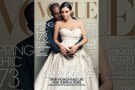
Image Source: yahoo.com “There’s no way Kim Kardashian shouldn’t be on the cover of Vogue, she’s like the most intriguing woman right now. She’s got Barbara Walters calling her like everyday.”None other than Kanye West, the loudest—and most innovative—voice in hip-hop, made this proclamation to Ryan Seacrest in an interview late last year.
West finally got his wish.
The couple will grace the cover of Vogue’s April issue. Shot by famed photographer Annie Leibovitz, the image resembles a mock wedding photo, with Kardashian in a cream-colored wedding gown flanked by West in a blue suit, and is accompanied by the headline: “KIM & KANYE: Their fashionable life and surreal times” as well as the lengthy hashtag “#WORLDSMOSTTALKEDABOUTCOUPLE”—an apparent nod to West’s viral disclaimer that he tapped out amid his mini-feud with late night host Jimmy Kimmel: #NODISRESPECTTOBENAFFLECK.
Kardashian was elated by the news.
And understandably so. There had been rumors flying for years that Vogue editrix Anna Wintour had it out for Kardashian. New York magazine reported that the reality star-entrepreneur had been banned for years from the Wintour-curated Met Gala, one of the biggest events of the fashion season that attracts every A-lister imaginable. Kardashian finally attended the mega-event last year, accompanied by West, but was conveniently cropped out of Vogue’s Best Dressed gallery. And just last March, a vicious rumor was reported by various publications that Wintour had labeled the reality star-entrepreneur “the worst thing since socks and sandals.”
In May, Us Weekly reported that West and Kardashian dined with Wintour at her New York City home—just months before the hip-hop impresario proposed to her at San Francisco’s AT&T Park while a 50-person orchestra played Lana Del Rey’s sultry ballad “Young and Beautiful.”
Any rumored beef between fashion’s gatekeeper and the superstar couple has been quashed, according to Wintour’s letter from the editor in the issue.
“Part of the pleasure of editing Vogue, one that lies in a long tradition of this magazine, is being able to feature those who define the culture at any given moment, who stir things up, whose presence in the world shapes the way it looks and influences the way we see it. I think we can all agree on the fact that that role is currently being played by Kim and Kanye to a T. (Or perhaps that should be to a K?),” she wrote.
“As for the cover, my opinion is that it is both charming and touching, and it was, I should add, entirely our idea to do it; you may have read that Kanye begged me to put his fiancée on Vogue‘s cover. He did nothing of the sort. The gossip might make better reading, but the simple fact of the matter is that it isn’t true.”
There were, nonetheless, hordes of detractors—including Buffy the Vampire Slayer’s Sarah Michelle Gellar, of all people—who took to Twitter to voice their disapproval over the Kimye cover.
Seems a bit precious. Vogue has, after all, previously featured The Spice Girls, Britney Spears, Sienna Miller, and more on its cover, and has been angling towards more celebrity-driven content for ages, so why not Kimye, arguably the fourth most popular couple in the country (after the Obama’s, Jay Z-Beyoncé, and Jolie-Pitt)? It's no longer the highbrow mecca of fashion it once was.
Showing posts with label fashion. Show all posts
Showing posts with label fashion. Show all posts
Thursday, March 27, 2014
REPOST: The Kimye-Vogue Backlash
Anna Wintour’s decision to put Kim Kardashian and Kanye West on the cover of Vogue did not sit well with subscribers, fashionistas, and concerned citizens who question Kardashian’s credibility to grace the renowned magazine. This article discusses the public backlash.

Tuesday, December 17, 2013
REPOST: The Biggest Fashion News of 2013
2013 is about to end but not without a recap of the year's biggest stories that shook the fashion industry. Blue Carreon rounds up these events on Forbes.
The departure of Marc Jacobs from Louis Vuitton easily takes the cake. Jacobs announced his departure immediately after his spring 2014 show for Louis Vuitton, a show he dedicated to his many muses with a set that featured many of his iconic props from his past 16 years at the maison.
Jil Sander left the house she founded for the third time leaving many to question the future of the well-loved brand. Personal reasons were reported to be the impetus for her exit.
In early 2013, Alexander Wang showed his first collection for Balenciaga. Unsure of what to expect from the designer largely known for his stylish take on t-shirts and sweats, Wang surpassed expectations with his confident first showing which featured constructed separates, coats with that Balenciaga cocoon effect, peplum skirts and a marble print.
In April 2013, Dolce & Gabbana were reported to have been found guilty of tax evasion and were handed a fine of roughly 343 euros and a jail sentence of under two years. The design duo protested the ruling by closing its stores. In a statement, they maintained that they “live in Italy, we pay taxes in Italy.”
Working conditions in clothing factories, especially those in Bangladesh, were exposed after a couple of tragedies including a deadly fire and the worst of all, the collapse of a factory building which killed over 1000 workers.
H&M launched its collaboration with French designer Isabel Marant. Reed Krakoff, the designer and visionary who made Coach the behemoth that it is now, announced in April that he wasn’t going to renew his contract with Coach when it expires in June 2014 because he wants to concentrate on his eponymous label.
First Lady Michelle Obama picked one of Krakoff’s designs for the official swearing-in for her husband’s second term. Throughout the inauguration events, she wore pieces from Thom Browne and Michael Kors. For the inauguration ball, she chose a gown from Jason Wu, the same designer who made her first inauguration frock.
Across the pond, Kate Middleton, the Duchess of Cambridge, was the epitome of impeccable maternity style. She opted to wear beautifully cut A-line dresses and coats while she carried her first born.
The Metropolitan Museum of New York was invaded by punks or at least by those who tried to channel the punk culture with the Costume Institute exhibit from Punk: From Chaos to Couture. Paris held a retrospective of Azzedine Alaia’s work at the Palais Galliera in the Musee de la Mode, which rivaled Paris Fashion Week. And the Brooklyn Museum staged a well-received exhibition of Jean Paul Gaultier’s body of work.
Fashionista Elizabeth Rehnke likes to step out in style all year round. Follow her on this Google page for news on fashion trends.
 |
| English: Marc Jacobs (Photo credit: Wikipedia) Image Source: forbes.com |
The departure of Marc Jacobs from Louis Vuitton easily takes the cake. Jacobs announced his departure immediately after his spring 2014 show for Louis Vuitton, a show he dedicated to his many muses with a set that featured many of his iconic props from his past 16 years at the maison.
Jil Sander left the house she founded for the third time leaving many to question the future of the well-loved brand. Personal reasons were reported to be the impetus for her exit.
In early 2013, Alexander Wang showed his first collection for Balenciaga. Unsure of what to expect from the designer largely known for his stylish take on t-shirts and sweats, Wang surpassed expectations with his confident first showing which featured constructed separates, coats with that Balenciaga cocoon effect, peplum skirts and a marble print.
 |
| Balenciaga, fall 2013 Image Source: runway.blog.nytimes.com |
In April 2013, Dolce & Gabbana were reported to have been found guilty of tax evasion and were handed a fine of roughly 343 euros and a jail sentence of under two years. The design duo protested the ruling by closing its stores. In a statement, they maintained that they “live in Italy, we pay taxes in Italy.”
Working conditions in clothing factories, especially those in Bangladesh, were exposed after a couple of tragedies including a deadly fire and the worst of all, the collapse of a factory building which killed over 1000 workers.
H&M launched its collaboration with French designer Isabel Marant. Reed Krakoff, the designer and visionary who made Coach the behemoth that it is now, announced in April that he wasn’t going to renew his contract with Coach when it expires in June 2014 because he wants to concentrate on his eponymous label.
First Lady Michelle Obama picked one of Krakoff’s designs for the official swearing-in for her husband’s second term. Throughout the inauguration events, she wore pieces from Thom Browne and Michael Kors. For the inauguration ball, she chose a gown from Jason Wu, the same designer who made her first inauguration frock.
Across the pond, Kate Middleton, the Duchess of Cambridge, was the epitome of impeccable maternity style. She opted to wear beautifully cut A-line dresses and coats while she carried her first born.
 |
| (Source: WPA Pool/Getty Images Europe, Newspix/Bauer-Griffin.Com, Gf/Bauer Griffin) Image Source: stylebistro.com |
The Metropolitan Museum of New York was invaded by punks or at least by those who tried to channel the punk culture with the Costume Institute exhibit from Punk: From Chaos to Couture. Paris held a retrospective of Azzedine Alaia’s work at the Palais Galliera in the Musee de la Mode, which rivaled Paris Fashion Week. And the Brooklyn Museum staged a well-received exhibition of Jean Paul Gaultier’s body of work.
Fashionista Elizabeth Rehnke likes to step out in style all year round. Follow her on this Google page for news on fashion trends.
Friday, October 11, 2013
REPOST: Giambattista Valli: Looking Beyond the Clothes
This New York Times piece talks about Giambattista Valli’s coffee table book revealing the private side of the flamboyant designer.
Florida-based Elizabeth Rehnke is into fashion, sports, and travelling. Like this Facebook page to stay updated on the fashionista’s latest pursuits.
Image Source: nytimes.com
Giambattista Valli’s career is a little young to be the subject of a coffee-table book. He started his signature label only in 2005 and became a couturier two years ago, so how to fill the nearly 400-page book ($100) being published this month from Rizzoli?

“I wanted to do something different,” Mr. Valli said. “I wanted to get naked. I didn’t want to show only the facade but to invite the reader into the most private side of my profession.”
He is not literally naked. Rather, Mr. Valli is barely seen in the book, beyond a few images of him working on his collection, adjusting the details, or in a portrait by Francesco Clemente that shows the designer wearing his customary pearl necklace.But you do see his inspirations clearly, like how dresses that appear to be made of hydrangea blossoms are linked to the sculptures of Louise Bourgeois and Piero Manzoni. Mr. Valli also included an image of Lee Radziwill and Jackie Kennedy sitting on the ground because it showed the sort of relaxed beauty that informs his work. “This not an egocentric kind of book,” he said. “This is simply my method that I wanted to share with other people.”
Florida-based Elizabeth Rehnke is into fashion, sports, and travelling. Like this Facebook page to stay updated on the fashionista’s latest pursuits.
Tuesday, August 27, 2013
REPOST: Feel-Good Fashion: The New Black
Is the fashion world transforming to "a world of good goods?" In their article for The Wall Street Journal, Laura Neilson and Meenal Mistry discuss how a growing number of companies are laying bare everything consumers could ever want to know about—from the making of their T-shirts to their tote bags.
Elizabeth Rehnke lauds the move of fashion houses to become more transparent about how they produce their goods. Like this Facebook page for more discussions and updates about the fashion industry.
HOLY COW | Made by hand, of locally sourced leather, this bag meets the ethical standards set by new e-commerce site Zady. Alice D Milano Bag in Taupe and Black, $475, zady.com (Image source: wsj.com)

A FEW WEEKS AGO, Michael Preysman, the founder of fashion label Everlane, and his head of creative, Alexandra Spunt, went on a seven-day road trip through China to visit the factories where their silk blouses and cashmere sweaters are made. The purpose of the sojourn: to check in with their factories, and share their findings with customers via videos and photos to be posted on the Everlane website.
An earlier video series showing their T-shirt factory in Los Angeles had been quite popular with online visitors, said Mr. Preysman. "So we said, 'Hey why don't we tackle China?' "
The reason for the journey was partly to address skepticism surrounding Chinese facilities. "We wanted to clear up this misconception around China," said Mr. Preysman. "You can actually work with really great factories over there. And for silk, China is the best in the world." Videos and detailed images of the trip are now on the company's Tumblr page and will soon appear on its website, alongside products made there.
Everlane isn't the only fashion brand to make transparent production central to its philosophy. Just as the Slow Food movement prizes practices that are gentle on the land and the body, a wave of labels and retailers are focusing on socially responsible methods. These companies appeal to the growing number of consumers who want to know what kind of impact their purchases will have—both on the environment and, now more than ever, on other human beings.
Sweatshop labor—and the ethical issues surrounding it— is nearly as old as the Industrial Revolution. In more recent history, Nike was widely criticized for its factory practices in the '90s and early '00s; but the company has made efforts to improve its methods. Since 2005, Nike discloses the name and address of every factory it uses.
However, the issue has exploded in the past year after two major factory disasters in Bangladesh together killed more than 1,200 garment workers who were making clothes for Western companies. In response, many large companies—including H&M; Inditex, which owns Zara; and PVH, which owns Calvin Klein and Tommy Hilfiger—recently signed the Accord on Fire and Building Safety in Bangladesh, an unprecedented agreement between companies and labor unions. "It's binding and enforceable; it isn't a voluntary program," said Scott Nova, the executive director of the Worker Rights Consortium, which helped develop the Accord. "There's an actual commitment from the brands and retailers to pay for the cost of making factories safe, which is a commitment they've never made before."
Still, wary consumers tend to flock to businesses that are small and independent. "The fashion industry is so globalized and uses such convoluted supply chains," said Elizabeth L. Cline, author of "Overdressed: The Shockingly High Cost of Cheap Fashion." "It's really the smaller fashion companies who are going to be able to provide true transparency to consumers."
Bringing many of those companies' products together in a single stylish, information-crammed location is the goal of Zady, an e-commerce site set to launch Aug. 27. Zady (pronounced zay-dee, which is both Yiddish for "grandfather" and an Arabic girl's name meaning "prosperity"), is the brainchild of Maxine Bédat, a former law clerk for the United Nations, and Soraya Darabi, a former digital media strategist and co-founder of the app Foodspotting. The site will carry some 40 labels, both American and international, including Steven Alan, Imogene + Willie denim and the English heritage brand Gloverall—a roster the owners plan to keep expanding. "We're not trying to be the neighborhood shop," said Ms. Darabi. "We want to be a global destination for people who care about the origins of products."
Ms. Bédat has some experience in ethical retailing. In 2010, she co-founded the Bootstrap Project, a nonprofit site, while working in Tanzania at the International Criminal Tribunal for Rwanda, which was prosecuting perpetrators of the genocide. In her free time, she would explore markets where she noticed that many so-called "local crafts" were made in China, while real artisans had trouble finding customers. "In globalization, those jobs and traditions were getting lost," said Ms. Bédat. "The idea behind Bootstrap was to revive them and bring jobs back to the community." On its website, you can buy a printed clutch bag from Zambia or provide a microloan to its maker—or both.
Ms. Darabi, who worked for the New York Times, was an adviser for Bootstrap. But in the pair's conversations, said Ms. Darabi, "we realized there was a for-profit venture we needed to talk about."
Enter Zady. The site uses icons to let shoppers know at a glance if something is locally sourced (to qualify if an items' raw materials come from within 100 miles of where it's made), handmade, made in the U.S., made from high-quality raw materials, environmentally conscious (e.g. made with vegetable dyes) and whether it's affiliated with the Bootstrap Project.
The site's vetting process is a work in progress. Ms. Bédat and Ms. Darabi, who are based in New York, research the practices of every brand they carry in different ways. They've visited some factories, but in many cases rely on the brands to disclose the information, requiring owners to sign contracts verifying the authenticity of their claims about sourcing and production.
"We're a small team," said Ms. Bédat. "We don't have people who are able to fly out and report back." As a result, they've turned down brands that work in countries with a known record of human-rights abuses. Instead, said Ms. Bédat, they've focused on American and European products, often from vertically integrated designers who don't outsource, making traceability a simpler prospect. As they branch out to developing countries, their plan is to work with labor organizations and human rights groups to verify that workers are safe and well-compensated.
One part of this quest for transparency is storytelling, which plays a major role in marketing strategy. Shoppers browsing Zady for Imogene + Willie's slim-cut indigo denim jeans ($225) or winter coats by Gloverall ($625) will be able to read a short brand history that the site's creators hope will provide a greater incentive to click "Buy."
The power of the story is something clearly understood by Claire Mazur and Erica Cerulo, the duo behind Of a Kind, a New York-based e-commerce site that sells limited-edition apparel and accessories by independent designers. Each label gets an introduction, often followed by related featurettes, like one on bag designer Clare Vivier's favorite Los Angeles haunts and another on a vintage shopping trip she took in her hometown of St. Paul, Minn.
For Ms. Mazur, a former arts consultant, and Ms. Cerulo, who was an editor at Details and Lucky magazines, the stories have been essential. "How do you convince someone to spend $300 dollars on a designer they might not have heard of, on a product they've never touched?" said Ms. Mazur. "If you can tell them that story and give them that emotional attachment, we think that's going to work." Last year, Ms. Mazur said, the company's revenues were up 300% from the previous year, and the site has been turning a profit for the past nine months.
Another factor in the decision to buy is trust in fair pricing. Certainly this new conscious consumer doesn't want to save money by exploiting third-world labor, but she also doesn't want to be fleeced. That's an area where Belgian designer Bruno Pieters's venture, called Honest By, which was founded early last year, might be unmatched.
Mr. Pieters's company provides painstakingly detailed information for each item it sells: the source of every material, trimming and thread; the address and owner of its production facility; its cost breakdown and markup, as well as its carbon footprint. "I never thought about transparency or things like sustainability. You just assume it will be fine," said Mr. Pieters, who used to design for his own luxury label, as well as Hugo Boss, before taking a sabbatical in 2009.
Everlane, too, publishes the cost breakdown of each piece on its blog. The San Francisco-based company said it is able to offer high-quality basics like Supima cotton T-shirts and silk button-down blouses at prices lower than those of luxury competitors by selling only online, which keeps overhead to a minimum. Everlane products are sold at a markup of about 220% versus the industry norm of 500% to 800% times the cost-to-manufacture price.
Unlike Mr. Pieters, however, Everlane's Mr. Preysman doesn't disclose the names and addresses of factories, explaining that he doesn't want competitors moving in on his turf. However, the company uses third-party auditors to ensure its living-wage and safety standards.
Still, wary consumers tend to flock to businesses that are small and independent. "The fashion industry is so globalized and uses such convoluted supply chains," said Elizabeth L. Cline, author of "Overdressed: The Shockingly High Cost of Cheap Fashion." "It's really the smaller fashion companies who are going to be able to provide true transparency to consumers."
Bringing many of those companies' products together in a single stylish, information-crammed location is the goal of Zady, an e-commerce site set to launch Aug. 27. Zady (pronounced zay-dee, which is both Yiddish for "grandfather" and an Arabic girl's name meaning "prosperity"), is the brainchild of Maxine Bédat, a former law clerk for the United Nations, and Soraya Darabi, a former digital media strategist and co-founder of the app Foodspotting. The site will carry some 40 labels, both American and international, including Steven Alan, Imogene + Willie denim and the English heritage brand Gloverall—a roster the owners plan to keep expanding. "We're not trying to be the neighborhood shop," said Ms. Darabi. "We want to be a global destination for people who care about the origins of products."
Ms. Bédat has some experience in ethical retailing. In 2010, she co-founded the Bootstrap Project, a nonprofit site, while working in Tanzania at the International Criminal Tribunal for Rwanda, which was prosecuting perpetrators of the genocide. In her free time, she would explore markets where she noticed that many so-called "local crafts" were made in China, while real artisans had trouble finding customers. "In globalization, those jobs and traditions were getting lost," said Ms. Bédat. "The idea behind Bootstrap was to revive them and bring jobs back to the community." On its website, you can buy a printed clutch bag from Zambia or provide a microloan to its maker—or both.
Ms. Darabi, who worked for the New York Times, was an adviser for Bootstrap. But in the pair's conversations, said Ms. Darabi, "we realized there was a for-profit venture we needed to talk about."
Enter Zady. The site uses icons to let shoppers know at a glance if something is locally sourced (to qualify if an items' raw materials come from within 100 miles of where it's made), handmade, made in the U.S., made from high-quality raw materials, environmentally conscious (e.g. made with vegetable dyes) and whether it's affiliated with the Bootstrap Project.
The site's vetting process is a work in progress. Ms. Bédat and Ms. Darabi, who are based in New York, research the practices of every brand they carry in different ways. They've visited some factories, but in many cases rely on the brands to disclose the information, requiring owners to sign contracts verifying the authenticity of their claims about sourcing and production.
"We're a small team," said Ms. Bédat. "We don't have people who are able to fly out and report back." As a result, they've turned down brands that work in countries with a known record of human-rights abuses. Instead, said Ms. Bédat, they've focused on American and European products, often from vertically integrated designers who don't outsource, making traceability a simpler prospect. As they branch out to developing countries, their plan is to work with labor organizations and human rights groups to verify that workers are safe and well-compensated.
One part of this quest for transparency is storytelling, which plays a major role in marketing strategy. Shoppers browsing Zady for Imogene + Willie's slim-cut indigo denim jeans ($225) or winter coats by Gloverall ($625) will be able to read a short brand history that the site's creators hope will provide a greater incentive to click "Buy."
The power of the story is something clearly understood by Claire Mazur and Erica Cerulo, the duo behind Of a Kind, a New York-based e-commerce site that sells limited-edition apparel and accessories by independent designers. Each label gets an introduction, often followed by related featurettes, like one on bag designer Clare Vivier's favorite Los Angeles haunts and another on a vintage shopping trip she took in her hometown of St. Paul, Minn.
For Ms. Mazur, a former arts consultant, and Ms. Cerulo, who was an editor at Details and Lucky magazines, the stories have been essential. "How do you convince someone to spend $300 dollars on a designer they might not have heard of, on a product they've never touched?" said Ms. Mazur. "If you can tell them that story and give them that emotional attachment, we think that's going to work." Last year, Ms. Mazur said, the company's revenues were up 300% from the previous year, and the site has been turning a profit for the past nine months.
Another factor in the decision to buy is trust in fair pricing. Certainly this new conscious consumer doesn't want to save money by exploiting third-world labor, but she also doesn't want to be fleeced. That's an area where Belgian designer Bruno Pieters's venture, called Honest By, which was founded early last year, might be unmatched.
Mr. Pieters's company provides painstakingly detailed information for each item it sells: the source of every material, trimming and thread; the address and owner of its production facility; its cost breakdown and markup, as well as its carbon footprint. "I never thought about transparency or things like sustainability. You just assume it will be fine," said Mr. Pieters, who used to design for his own luxury label, as well as Hugo Boss, before taking a sabbatical in 2009.
Everlane, too, publishes the cost breakdown of each piece on its blog. The San Francisco-based company said it is able to offer high-quality basics like Supima cotton T-shirts and silk button-down blouses at prices lower than those of luxury competitors by selling only online, which keeps overhead to a minimum. Everlane products are sold at a markup of about 220% versus the industry norm of 500% to 800% times the cost-to-manufacture price.
Unlike Mr. Pieters, however, Everlane's Mr. Preysman doesn't disclose the names and addresses of factories, explaining that he doesn't want competitors moving in on his turf. However, the company uses third-party auditors to ensure its living-wage and safety standards.
Experts in the field of ethical sourcing and trade still encourage skepticism, no matter how warm and fuzzy a website makes one feel. "There is a lot of consumer concern, and there is a tendency for smaller companies to want to exploit it," said Mr. Nova of the Worker Rights Consortium. "That can be a very positive motivation, but the concern is that there are people who, out of cynicism or lack of understanding, are not making verifiable claims."
Experts in the field of ethical sourcing and trade still encourage skepticism, no matter how warm and fuzzy a website makes one feel. "There is a lot of consumer concern, and there is a tendency for smaller companies to want to exploit it," said Mr. Nova of the Worker Rights Consortium. "That can be a very positive motivation, but the concern is that there are people who, out of cynicism or lack of understanding, are not making verifiable claims."
Elizabeth Rehnke lauds the move of fashion houses to become more transparent about how they produce their goods. Like this Facebook page for more discussions and updates about the fashion industry.
Sunday, July 21, 2013
Punk fashion goes beyond chaos
 |
| Image source: metmuseum.org |
Does punk really mean chaos? Does punk provoke anarchy? Does punk desire to overthrow the hippies? These are some of the reflections of the Costume Institute of the Metropolitan Museum of Art in New York in the exhibition Punk: From Chaos to Couture.
 |
| Image source: metmuseum.org |
The mingling of fashion and punk is often misconstrued as an unfair juxtaposition, with both frequently overstepping one another in redefining each other. If the Elizabeth Rehnke style book is to be consulted, the key to understanding both is not in pitting them against each other as separate art entities, but by contextualizing them in a single process of transforming an idea into a visible creation that submits to the creators’ liking.
 |
| Image source: metmuseum.org |
The Punk: From Chaos to Couture exhibition deliberately goes beyond chaos to allow the designers’ intellectual forces merge with established realities surrounding punk culture and to let the designers’ own point of view flow freely through their creations. Fashion becomes the designers’ blank canvass while their cultural inclination becomes the style – this complementarity steers spectators toward cultural investigation.
Click here for more fashion and style tidbits, courtesy of Elizabeth Rehnke.
Monday, January 7, 2013
REPOST: The Clothes Make the ‘Girls’
Karen Schwartz ponders on the fashion sense of the main characters of the HBO hit series Girls. In her article for The New York Times, she notes that Girls may be antiglamour, but, in keeping with the show’s search-for-identity theme, it is very much about personal style.
MAYBE it was the episode when Hannah, the main character on the HBO series “Girls,” wore a cardigan festooned with tomatoes to her first paid job, at a law office. Or the one in which Marnie, her uptight best friend, wore a bright little cocktail dress to a Bushwick loft party. Or the one where Jessa wore a long see-through eyelet dress over hot pink underwear to her gig as a nanny.
It’s hard to pin down the exact moment, but at some point while watching the show last spring, I had an unexpected flashback to an ensemble I wore when I was just out of college: a black romper with knickers paired with a white oxford shirt, a red necktie and tights with Lichtenstein-esque cartoons on them. I referred to this get-up as my “signature outfit” and wore it primarily on job interviews.
Such is the difference between “Girls,” whose second season begins on Jan. 13, and its most obvious predecessor, “Sex and the City.” You watched Sarah Jessica Parker et al and thought, I wish I had those shoes. You watch Lena Dunham and crew and think, There, with the grace of God, I wenteth.
The fashions on “Girls” may not be aspirational, but they are very much intentional. “We are very conscious about what the girls are wearing,” said Ms. Dunham, the show’s 26-year-old creator/writer/director, who plays Hannah. “We spend a lot of time talking about that outfit you can’t believe you wore but you know you spent three days dreaming up.”
The show’s costume designer, Jennifer Rogien, agreed. “The overall theme of the show is all the mistakes we go through when we’re trying to find our footing,” she said. “We wanted to embrace all those factors — the youth, the first job, the insecurity in relationships, both romantic and friendship — and see if we could reflect that through the clothing.”
Where “Sex and the City” created a high-end designer-driven fantasy, “Girls” strives above all else for authenticity. “We were really concerned about realism, verisimilitude,” Ms. Dunham said, adding that Jenni Konner, an executive producer, “is always there at my costume fittings to say, ‘That fits a little too well.’ ”
“She’s always calling out the potential for any TV-matchy-cutesy-ness,” Ms. Dunham said. Key to this ethos, Ms. Konner said, is “never having things that are beyond what these girls can afford.” The show’s most polished looks come from designers like Theory and Tibi, and the decidedly un-Carrie Bradshaw Ann Taylor. Characters also wear some clothes repeatedly. “Hannah had a pair of very well-loved Rachel Antonoff for Bass loafers that she wore a lot in Season 1,” Ms. Rogien said.
Ms. Dunham said that whenever she saw those shoes, “I was like: ‘Oh, yay! My loafers!’ ” (Side fact: Those shoes were designed by the sister of Jack Antonoff, who is a member of the Grammy-nominated band Fun., and also Ms. Dunham’s boyfriend.)
“It always makes me so crazy when people on shows have a new winter coat every day,” Ms. Dunham said. “I wore the same winter coat for three years after college, even after my dog peed on it.”
Like the experiences portrayed on the show, wardrobes are often imbued with autobiographical specificity. “I once got in a fight with one of my best friends while she was wearing a plastic dress,” Ms. Dunham said. “And the plastic dress became an example of our conflict — like, ‘You’re changing, you’re wearing a plastic dress.’ The plastic dress found a home in Season 2.”
The show often draws the viewer’s attention to its characters’ sartorial crimes. When Hannah reports to her first day of work at a coffee shop in a white dress, her boss tells her to go home and change, saying, “This isn’t a consumptive women’s hospital.” Seeing Marnie in a low-cut floral dress, a character greets her with, “Hello, J.Lo at the Grammys.” In a memorable moment early in Season 2, Marnie, played by Allison Williams, calls Hannah out on her hilariously awful neon mesh top by saying, “What are you wearing?”
“Girls” may be antiglamour, but, in keeping with the show’s larger search-for-identity theme, it is very much about personal style.
The wardrobes, said Ms. Rogien, who previously worked on “The Good Wife” and “Bored to Death,” “are extremely character-driven.”
For these characters, outfits are an important form of self-expression, Ms. Dunham said. “The clothes are really meant to reflect the fantasy the girls have about themselves and are sort of unsuccessfully fulfilling,” she said.
Each girl has her own distinct style. Hannah, Ms. Rogien said, is “lovingly disheveled.” Much of Hannah’s mix-and-match outfits comes from vintage and thrift stores and sometimes yield looks that don’t look that flattering on the character. “But she’s fully committed to them,” Ms. Rogien explained. In fact, she said, “sometimes we tailor the clothes to fit her even worse.”
Marnie, Hannah’s uptight best friend, suffers from the opposite problem. “She’s very put together,” Ms. Rogien said. Marnie favors structured sheath dresses and wears pieces from Black Halo and DVF. “She’s trying really hard to be professional, to be grown-up, and sometimes she overshoots.” As in Season 1, when she dons a Tibi dress and pumps for a party in Bushwick. “She’s wearing essentially a bat mitzvah dress to a grungy loft party,” Ms. Rogien said.
Shoshanna, the quirkily nervous New York University student played by Zosia Mamet, is the most concerned with outfit propriety. “She’s someone whose reading every book, every magazine and kind of using every fashion rule together at once,” Ms. Konner said.
And she shops, as Ms. Rogien explained. “She’s got both time and potentially a little money to do a little bit of shopping, she said. “We shop her in Bloomingdale’s and Saks.” Shoshanna is also a big fan of loungewear. She has been known to sport a Juicy Couture sweatsuit, and memorably watched TV in a purple peace-sign snuggy. (“I love that snuggy,” Ms. Rogien said.)
Ms. Mamet said: “It’s about the proper attire for every moment. Even her pajamas match.”
And the bohemian Jessa, played by Jemima Kirke, is, Ms. Dunham said, “a girl with an innately cool sense of style whose confidence can veer into the crazily inappropriate.” Not only did Jessa wear the aforementioned sheer dress to baby-sit (“it’s floor-length,” she said, by way of justification), but she also wore a bathrobe, Ugg boots and geisha-esque hair and makeup to meet up with an ex-boyfriend for a stroll in the park.
The character’s style is, in fact, quite similar to Ms. Kirke’s in real life. “I went to high school with Jemima,” Ms. Dunham said, “and dressing like Jemima was the top pursuit of every girl.”
Many of Jessa’s clothes have, in fact, been based on Ms. Kirke’s real-life outfits, and, in the case of some pieces, like her quickie wedding dress, culled from Geminola, the West Village store owned by her mother, the designer Lorraine Kirke. The elder Ms. Kirke’s repurposed vintage designs were featured on “Sex and the City,” and Ms. Dunham herself worked at Geminola during college.
The store, a small space on a quaint street with ripped wallpaper and tasseled chandeliers where the majority of prices fall in the $295-to-$695 range, seems like a place Jessa could grow up to own. “It’s a little bit Moulin Rouge brothel,” Ms. Dunham said, “but also sort of a sophisticated French salon. Jemima’s house is kind of that way, too.”
Ms. Dunham recalled that, when she worked there, “It would be like no one would come in all day, and then like some really fancy model would come in and buy 15 chandeliers and 9 dresses.”
In a recent phone interview, Ms. Kirke, the designer/proprietor, said that she didn’t recall Ms. Dunham’s time in her store. “But Jemima” — who could be heard in the background — “says I was horrible to her,” she added. “Basically, I started the store to give my daughters’ friends weekend jobs.”
Ms. Dunham’s own long connection to fashion raises an obvious question. Not only did Ms. Dunham, a child of two artists and a graduate of Brooklyn’s St. Ann’s School, work at Geminola, but she also was recently shot by Annie Leibovitz in the outfit that her baby sitter, the designer Zac Posen, made her for her high-school graduation.
Surely, Ms. Dunham’s personal style must diverge from Hannah’s? After all, she did wear Prada to the Emmys.
“Hannah dresses similarly to the way I dressed in late college or when I just graduated,” Ms. Dunham said. “I was less concerned with things looking good on me and more concerned with things being funny or interesting or quirky. I was a really big proponent of the sacklike bubble dress, unfortunately.”
Ms. Konner described Ms. Dunham’s look. “Lena dresses not only much older than Hannah, but much older than her age,” she said. “She’s very ladylike. I rarely see her wearing jeans, and when she does it’s with some kind of stylish blazer.”
Ms. Dunham said: “I always like to think of myself as dressing like a fancy lady at Radcliffe. That’s my fantasy about what’s going on.”
In this respect, Ms. Dunham, who has drawn much attention for her willingness to expose her decidedly non-Hollywood body, is equally notable for her choices when clothed.
When given creative control, few actresses have decided to create characters who look worse on television than they themselves do in life. Lucille Ball had no problem stuffing chocolates in her mouth off an assembly line or crushing grapes with her feet, but she did so in perfect hair and makeup. Tina Fey’s Liz Lemon makes self-deprecating jokes about her still-quite attractive appearance. Even Roseanne Barr, the foremother of female-driven sitcom realism, grew prettier, slimmer and more made-up as her show continued its run.
“The first time I met Lena,” Ms. Konner recalled, “was after seeing ‘Tiny Furniture,’ ” Ms. Dunham’s debut feature film. “I remember being like, Oh, my God, you’re so pretty! She plays herself down so much, which was surprising because it’s so unusual.”
Ms. Dunham said she knew “it wouldn’t be everyone’s choice.” But, she added: “I’m never tortured by seeing bad photographs of myself either. It’s not an ‘I need to do this for the sisterhood’ thing. It’s just a sense of trying to stay true to the characters and what we’re writing about.”
Fashion is just one of the many interests of Elizabeth Rehnke. Check out this Twitter account for more musings about fashion and personal style.
 |
| Image source: The New York Times |
MAYBE it was the episode when Hannah, the main character on the HBO series “Girls,” wore a cardigan festooned with tomatoes to her first paid job, at a law office. Or the one in which Marnie, her uptight best friend, wore a bright little cocktail dress to a Bushwick loft party. Or the one where Jessa wore a long see-through eyelet dress over hot pink underwear to her gig as a nanny.
It’s hard to pin down the exact moment, but at some point while watching the show last spring, I had an unexpected flashback to an ensemble I wore when I was just out of college: a black romper with knickers paired with a white oxford shirt, a red necktie and tights with Lichtenstein-esque cartoons on them. I referred to this get-up as my “signature outfit” and wore it primarily on job interviews.
Such is the difference between “Girls,” whose second season begins on Jan. 13, and its most obvious predecessor, “Sex and the City.” You watched Sarah Jessica Parker et al and thought, I wish I had those shoes. You watch Lena Dunham and crew and think, There, with the grace of God, I wenteth.
The fashions on “Girls” may not be aspirational, but they are very much intentional. “We are very conscious about what the girls are wearing,” said Ms. Dunham, the show’s 26-year-old creator/writer/director, who plays Hannah. “We spend a lot of time talking about that outfit you can’t believe you wore but you know you spent three days dreaming up.”
The show’s costume designer, Jennifer Rogien, agreed. “The overall theme of the show is all the mistakes we go through when we’re trying to find our footing,” she said. “We wanted to embrace all those factors — the youth, the first job, the insecurity in relationships, both romantic and friendship — and see if we could reflect that through the clothing.”
Where “Sex and the City” created a high-end designer-driven fantasy, “Girls” strives above all else for authenticity. “We were really concerned about realism, verisimilitude,” Ms. Dunham said, adding that Jenni Konner, an executive producer, “is always there at my costume fittings to say, ‘That fits a little too well.’ ”
“She’s always calling out the potential for any TV-matchy-cutesy-ness,” Ms. Dunham said. Key to this ethos, Ms. Konner said, is “never having things that are beyond what these girls can afford.” The show’s most polished looks come from designers like Theory and Tibi, and the decidedly un-Carrie Bradshaw Ann Taylor. Characters also wear some clothes repeatedly. “Hannah had a pair of very well-loved Rachel Antonoff for Bass loafers that she wore a lot in Season 1,” Ms. Rogien said.
Ms. Dunham said that whenever she saw those shoes, “I was like: ‘Oh, yay! My loafers!’ ” (Side fact: Those shoes were designed by the sister of Jack Antonoff, who is a member of the Grammy-nominated band Fun., and also Ms. Dunham’s boyfriend.)
“It always makes me so crazy when people on shows have a new winter coat every day,” Ms. Dunham said. “I wore the same winter coat for three years after college, even after my dog peed on it.”
Like the experiences portrayed on the show, wardrobes are often imbued with autobiographical specificity. “I once got in a fight with one of my best friends while she was wearing a plastic dress,” Ms. Dunham said. “And the plastic dress became an example of our conflict — like, ‘You’re changing, you’re wearing a plastic dress.’ The plastic dress found a home in Season 2.”
The show often draws the viewer’s attention to its characters’ sartorial crimes. When Hannah reports to her first day of work at a coffee shop in a white dress, her boss tells her to go home and change, saying, “This isn’t a consumptive women’s hospital.” Seeing Marnie in a low-cut floral dress, a character greets her with, “Hello, J.Lo at the Grammys.” In a memorable moment early in Season 2, Marnie, played by Allison Williams, calls Hannah out on her hilariously awful neon mesh top by saying, “What are you wearing?”
“Girls” may be antiglamour, but, in keeping with the show’s larger search-for-identity theme, it is very much about personal style.
The wardrobes, said Ms. Rogien, who previously worked on “The Good Wife” and “Bored to Death,” “are extremely character-driven.”
For these characters, outfits are an important form of self-expression, Ms. Dunham said. “The clothes are really meant to reflect the fantasy the girls have about themselves and are sort of unsuccessfully fulfilling,” she said.
Each girl has her own distinct style. Hannah, Ms. Rogien said, is “lovingly disheveled.” Much of Hannah’s mix-and-match outfits comes from vintage and thrift stores and sometimes yield looks that don’t look that flattering on the character. “But she’s fully committed to them,” Ms. Rogien explained. In fact, she said, “sometimes we tailor the clothes to fit her even worse.”
Marnie, Hannah’s uptight best friend, suffers from the opposite problem. “She’s very put together,” Ms. Rogien said. Marnie favors structured sheath dresses and wears pieces from Black Halo and DVF. “She’s trying really hard to be professional, to be grown-up, and sometimes she overshoots.” As in Season 1, when she dons a Tibi dress and pumps for a party in Bushwick. “She’s wearing essentially a bat mitzvah dress to a grungy loft party,” Ms. Rogien said.
Shoshanna, the quirkily nervous New York University student played by Zosia Mamet, is the most concerned with outfit propriety. “She’s someone whose reading every book, every magazine and kind of using every fashion rule together at once,” Ms. Konner said.
And she shops, as Ms. Rogien explained. “She’s got both time and potentially a little money to do a little bit of shopping, she said. “We shop her in Bloomingdale’s and Saks.” Shoshanna is also a big fan of loungewear. She has been known to sport a Juicy Couture sweatsuit, and memorably watched TV in a purple peace-sign snuggy. (“I love that snuggy,” Ms. Rogien said.)
Ms. Mamet said: “It’s about the proper attire for every moment. Even her pajamas match.”
And the bohemian Jessa, played by Jemima Kirke, is, Ms. Dunham said, “a girl with an innately cool sense of style whose confidence can veer into the crazily inappropriate.” Not only did Jessa wear the aforementioned sheer dress to baby-sit (“it’s floor-length,” she said, by way of justification), but she also wore a bathrobe, Ugg boots and geisha-esque hair and makeup to meet up with an ex-boyfriend for a stroll in the park.
The character’s style is, in fact, quite similar to Ms. Kirke’s in real life. “I went to high school with Jemima,” Ms. Dunham said, “and dressing like Jemima was the top pursuit of every girl.”
Many of Jessa’s clothes have, in fact, been based on Ms. Kirke’s real-life outfits, and, in the case of some pieces, like her quickie wedding dress, culled from Geminola, the West Village store owned by her mother, the designer Lorraine Kirke. The elder Ms. Kirke’s repurposed vintage designs were featured on “Sex and the City,” and Ms. Dunham herself worked at Geminola during college.
The store, a small space on a quaint street with ripped wallpaper and tasseled chandeliers where the majority of prices fall in the $295-to-$695 range, seems like a place Jessa could grow up to own. “It’s a little bit Moulin Rouge brothel,” Ms. Dunham said, “but also sort of a sophisticated French salon. Jemima’s house is kind of that way, too.”
Ms. Dunham recalled that, when she worked there, “It would be like no one would come in all day, and then like some really fancy model would come in and buy 15 chandeliers and 9 dresses.”
In a recent phone interview, Ms. Kirke, the designer/proprietor, said that she didn’t recall Ms. Dunham’s time in her store. “But Jemima” — who could be heard in the background — “says I was horrible to her,” she added. “Basically, I started the store to give my daughters’ friends weekend jobs.”
Ms. Dunham’s own long connection to fashion raises an obvious question. Not only did Ms. Dunham, a child of two artists and a graduate of Brooklyn’s St. Ann’s School, work at Geminola, but she also was recently shot by Annie Leibovitz in the outfit that her baby sitter, the designer Zac Posen, made her for her high-school graduation.
Surely, Ms. Dunham’s personal style must diverge from Hannah’s? After all, she did wear Prada to the Emmys.
“Hannah dresses similarly to the way I dressed in late college or when I just graduated,” Ms. Dunham said. “I was less concerned with things looking good on me and more concerned with things being funny or interesting or quirky. I was a really big proponent of the sacklike bubble dress, unfortunately.”
Ms. Konner described Ms. Dunham’s look. “Lena dresses not only much older than Hannah, but much older than her age,” she said. “She’s very ladylike. I rarely see her wearing jeans, and when she does it’s with some kind of stylish blazer.”
Ms. Dunham said: “I always like to think of myself as dressing like a fancy lady at Radcliffe. That’s my fantasy about what’s going on.”
In this respect, Ms. Dunham, who has drawn much attention for her willingness to expose her decidedly non-Hollywood body, is equally notable for her choices when clothed.
When given creative control, few actresses have decided to create characters who look worse on television than they themselves do in life. Lucille Ball had no problem stuffing chocolates in her mouth off an assembly line or crushing grapes with her feet, but she did so in perfect hair and makeup. Tina Fey’s Liz Lemon makes self-deprecating jokes about her still-quite attractive appearance. Even Roseanne Barr, the foremother of female-driven sitcom realism, grew prettier, slimmer and more made-up as her show continued its run.
“The first time I met Lena,” Ms. Konner recalled, “was after seeing ‘Tiny Furniture,’ ” Ms. Dunham’s debut feature film. “I remember being like, Oh, my God, you’re so pretty! She plays herself down so much, which was surprising because it’s so unusual.”
Ms. Dunham said she knew “it wouldn’t be everyone’s choice.” But, she added: “I’m never tortured by seeing bad photographs of myself either. It’s not an ‘I need to do this for the sisterhood’ thing. It’s just a sense of trying to stay true to the characters and what we’re writing about.”
Fashion is just one of the many interests of Elizabeth Rehnke. Check out this Twitter account for more musings about fashion and personal style.
Subscribe to:
Posts (Atom)